Oops! Something went wrong while submitting the form.
By clicking "Accept", you agree to the storing of cookies on your device to enhance site navigation, analyze site usage, and assist in our marketing efforts. View our Privacy Policy for more information.
Automating High-Volume Assembly for a 3-Piece Lens Case
Consumer Goods
The customer needed an automated assembly solution for a new 3-piece lens case project that would reduce labor requirements, improve assembly consistency, and support higher-volume production.
Customer Background
For high-volume consumer and life sciences products, manual assembly can quickly become difficult to scale. Repetitive assembly tasks require significant labor, create ergonomic strain, and introduce variation from operator to operator.
For this customer, the 3-piece lens case was a new project that required a more efficient way to assemble parts consistently. The customer needed to reduce manual labor while improving quality and meeting production requirements.
Automation offered a path to higher output, more repeatable assembly, and reduced dependency on manual labor for a repetitive production process.
The Challenge
The customer needed to assemble a 3-piece lens case at production scale.
The original challenge was not tied to a single production defect or machine issue. Instead, the customer needed a more scalable assembly process for a new product. Manual assembly would have required a large labor force, increased the risk of inconsistent assembly, and created repetitive motion concerns for operators.
For this application, quality also depended on proper cap threading. The caps needed to be assembled to a specific customer-required torque, which meant the machine had to do more than simply place parts together. It needed to control and verify the threading process.
The part geometry created an additional engineering challenge. The cap was physically larger than the base, which reduced the available clearance for properly locating the base while still allowing the upper tooling to torque the caps. Haumiller needed to design around that space constraint while maintaining part control and torque accuracy.
Why torque verification matters in automated assembly: For threaded components, proper torque helps confirm that the cap is assembled securely and consistently. Automated torque monitoring helps reduce variation and verify that the assembly meets customer requirements.
The Haumiller Solution
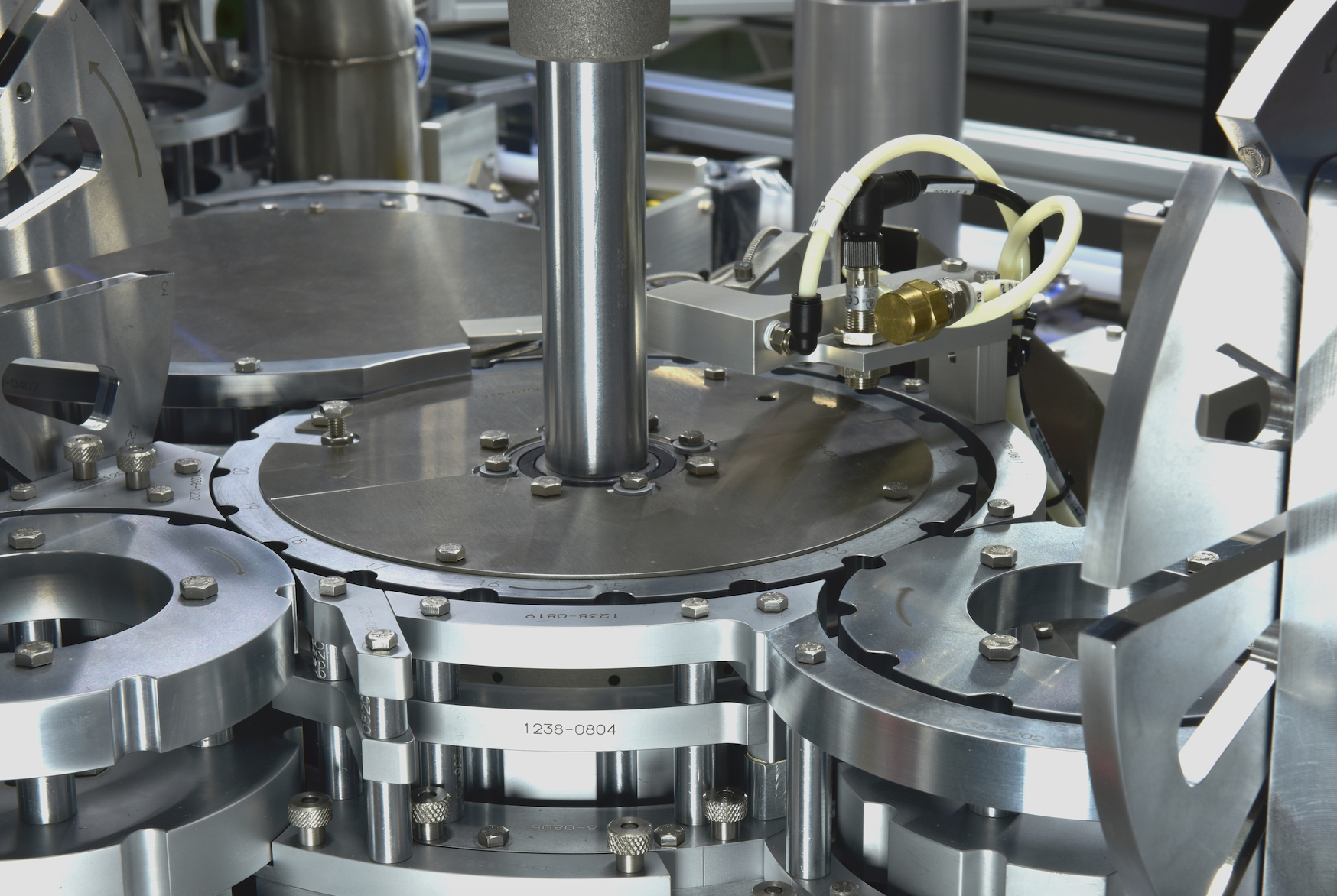
Haumiller designed a continuous motion assembly machine for the customer’s 3-piece lens case application.
The machine used rotary and vibratory feeders to deliver and orient parts at the required production rate. By using continuous motion instead of a standard indexing-style assembly approach, the system could keep parts moving through the process while allowing multiple stations to perform the same operation.
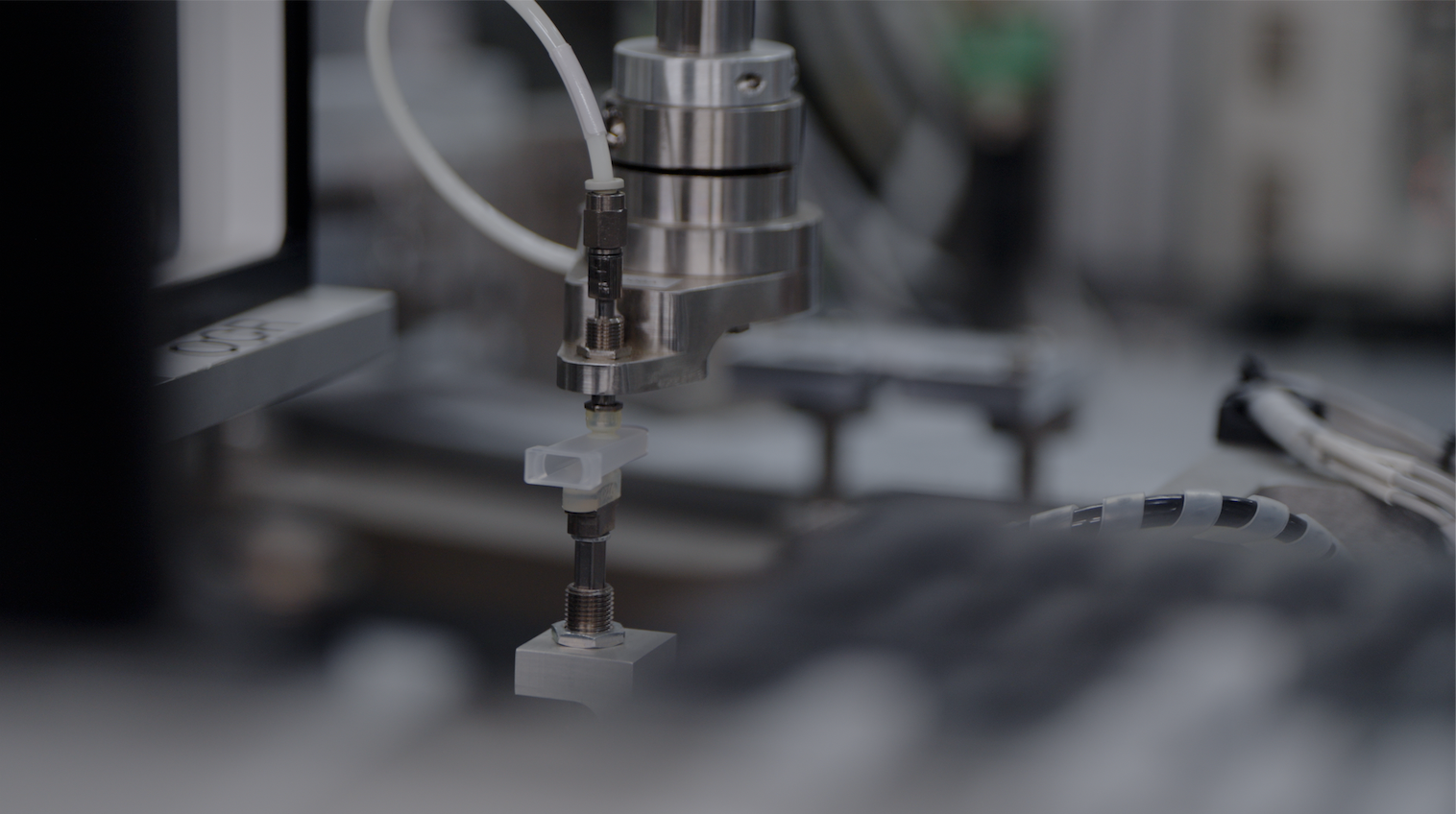
A key feature of the system was precision cap threading. Haumiller used stepper motors to thread the caps to the required torque. The machine verified the customer-required torque by monitoring and analyzing motor current during the threading process.
This allowed the system to support both assembly and verification within the automated process.
To address the clearance challenge created by the cap being larger than the base, Haumiller implemented thinner rails. This provided the clearance required for the upper tongue tooling while still allowing the base to be properly located during cap torquing.
Engineering Around Cap Size and Torque Control
One of the most important parts of the project was controlling the cap threading process within a limited amount of space.
Because the cap was larger than the base, standard locating and tooling approaches created clearance challenges. The machine needed to hold the base securely while allowing the upper tooling to access and torque the cap correctly.
Haumiller solved this by using thinner rails to create the required clearance for the upper tongue tooling. This design allowed the machine to maintain part location while completing the threading process.
The torque verification strategy added another layer of control. By monitoring motor current, the system could analyze whether the cap reached the required torque during assembly. This helped reduce reliance on manual inspection and supported a more consistent finished product.
Results and Impact
The project gave the customer an automated assembly solution for a new 3-piece lens case application.
Reduced labor requirements: The automated system reduced the need for manual assembly by allowing one continuous motion machine to handle a high-volume repetitive process.
Improved assembly consistency: Mechanical assembly helped reduce operator-to-operator variation and created a more repeatable process.
Precision cap threading: The machine used stepper motors to thread caps to the customer-required torque.
Torque verification: By monitoring and analyzing motor current, the system verified torque during the assembly process.
Higher output potential: Continuous motion assembly allowed multiple stations to perform the same operation, supporting higher throughput than a standard indexing-style assembly approach.
Reduced ergonomic strain: Automating a repetitive manual process helped reduce operator exposure to repetitive motions and awkward handling.
Improved production efficiency: By increasing output and reducing scrap caused by manual variation, the system helped support shorter production runs for the same quantity of finished parts.
Long-Term Value
This project reflects Haumiller’s ability to design custom continuous motion automation for products that require more than basic assembly.
For the customer, the value came from reducing labor dependency, improving consistency, and verifying a critical assembly requirement within the machine process. The system helped turn a repetitive manual operation into a controlled automated process built around part geometry, torque requirements, and production efficiency.
By combining continuous motion assembly, precision cap threading, torque monitoring, and custom tooling clearance, Haumiller delivered a solution built around the real requirements of the application.
Need to automate a threaded component assembly? Haumiller designs custom continuous motion systems built around precision assembly, torque control, part handling, and production requirements. Contact our team to discuss your next application.
.png)

.png)